A sole proprietor registers a business name on the DTI's BNRS site, picks a territorial scope and pays PhP 200 to PhP 2,000 plus a PhP 30 Documentary Stamp Tax within seven calendar days. The certificate lasts five years, but it does not let you operate on its own, because you still need a mayor's permit.
- Do you need a DTI business name at all?
- What should you prepare before opening BNRS?
- How much does DTI business name registration cost?
- Which territorial scope should you choose?
- Which business names does the DTI reject?
- How do you register on BNRS, screen by screen?
- How do you pay, and what happens if you miss the deadline?
- How do you get your certificate?
- What can you do when BNRS stops you?
- Which mistakes cost new owners time or money?
- How long does the registration last, and when do you renew?
- What comes after DTI: barangay, mayor's permit and BIR?
- Frequently asked questions
Do you need a DTI business name at all?
The DTI says that if you are doing business using a name other than your true name, you are required to register that business name. A business name is any name other than your own that appears on your receipts, agreements, signboard or billboard. Registration through BNRS is for sole proprietors, and any Filipino who is at least 18 years of age can register.
So a stall run as "Maria Santos" on every receipt does not need a business name, while the same stall trading as "〇〇 Kitchen" does. BNRS itself is built for sole proprietors; partnerships and corporations register with the Securities and Exchange Commission (SEC) instead.
Foreign nationals and refugees or stateless persons must also be at least 18, and online applications filed by non-Philippine nationals are processed only after the supporting documents are submitted at a DTI office and the applicable fees are paid. A non-Philippine national also needs a Certificate of Authority to Engage in Business under the Foreign Investment Act, so a foreign owner should plan an office visit instead of expecting a fully online process.
What should you prepare before opening BNRS?
The form moves in one direction, and after registration only typographical errors can be fixed by email. Have the items below ready in one place before you click New Registration.
- A valid government-issued ID, because the DTI help desk and the city both ask for one
- Two or three name ideas, each with a distinctive dominant word, not just a description of what you sell
- The exact address of the shop, stall or home office, down to the barangay
- Your residence address for the Residence Address section
- An email address you can open on the same day, since the verification code and certificate go there
- A payment channel you can use within the week: GCash, Maya, a credit or debit card, 7-Eleven or Bayad Center, or Landbank Link.Biz
- If someone files for you, an authorization letter you have signed and their valid ID
A representative can file the registration as long as they provide a valid ID and an authorization letter signed by the business owner together with the other requirements. If you need to stop halfway, BNRS lets you resume later through Transaction Inquiry with your reference code, so you do not have to finish everything in one sitting.
How much does DTI business name registration cost?
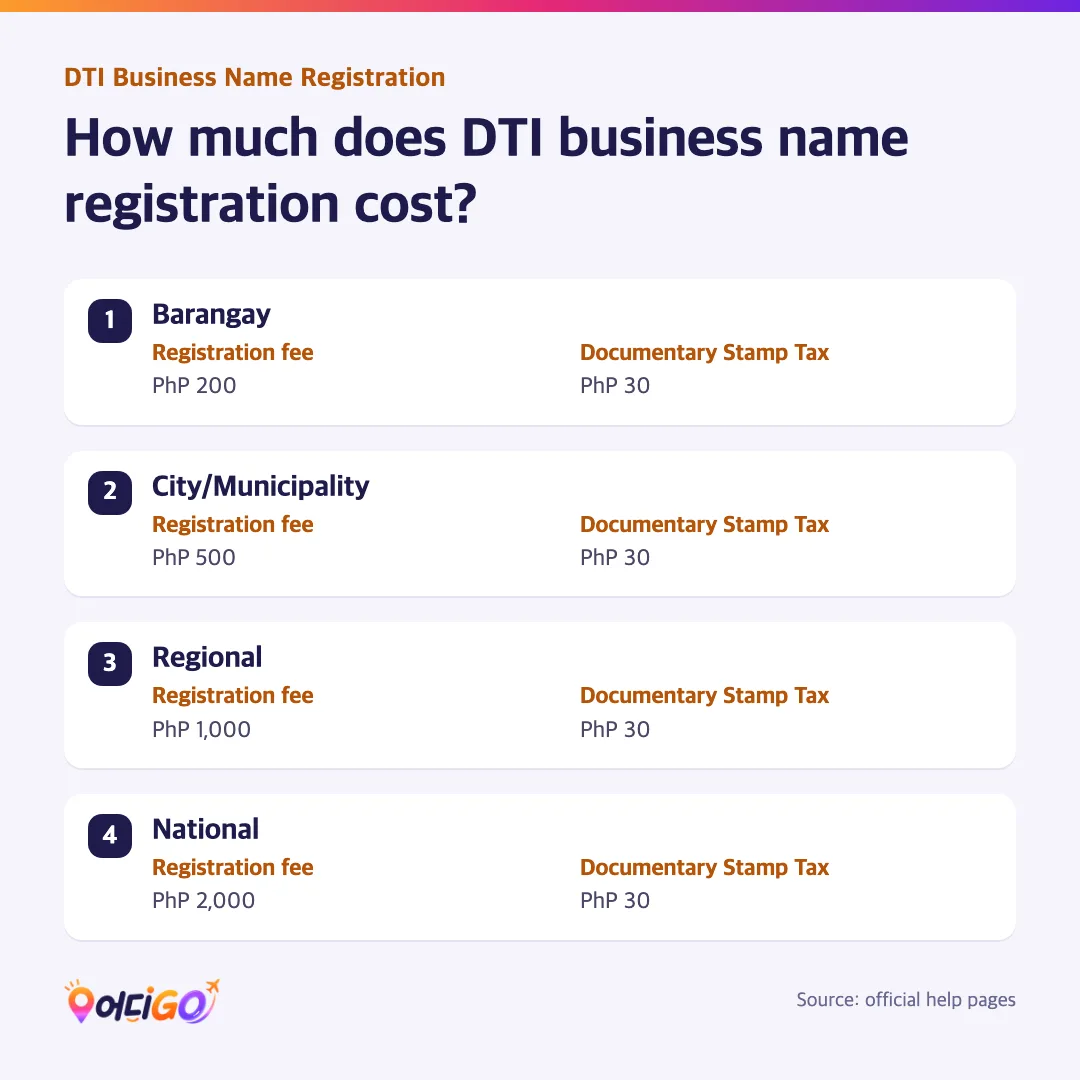
The fee is based on the territorial scope you choose, and every registration adds a PhP 30 Documentary Stamp Tax. After you pay the registration fee, the FAQ says there are no other payments to be made with BNRS.
| Territorial scope | Registration fee | Documentary Stamp Tax |
|---|---|---|
| Barangay | PhP 200 | PhP 30 |
| City/Municipality | PhP 500 | PhP 30 |
| Regional | PhP 1,000 | PhP 30 |
| National | PhP 2,000 | PhP 30 |
A late renewal costs more: the FAQ adds 50% to the registration fee for late filing, so the cheapest way to keep a name is to renew on time.
Which territorial scope should you choose?
The DTI defines territorial scope as the area where your offices, stores, branches or plants may be located, and says it is not the geographical limit in which you transact business. In other words, pick the scope by where your physical places of business sit, not by where your customers live.
This matters later at city hall. Quezon City's permit requirements, as published in its guide to amending a business permit, say the coverage level of your DTI registration must cover the location of the business, and the business name and owner's name must match the application. A barangay-scope name for a shop in another barangay is the kind of mismatch that sends you back to the DTI.
| Your situation | Scope to consider |
|---|---|
| One sari-sari store or food stall | Barangay |
| Online seller working from home | Barangay of the home address |
| Second branch planned in the same city | City/Municipality |
| Branches in two cities of one region | Regional |
| Branches in several regions | National |
Changing the scope later is treated as a new application, with a new certificate and a new validity period, and it is applied for at a DTI office. If a second branch is a firm plan rather than a hope, the wider scope at the start is usually less hassle than an upgrade.
Which business names does the DTI reject?
The DTI lists grounds for rejecting a name, and most refusals for small shops come from a handful of them. Knowing them before you type saves you from reserving a name that later fails.
- Purely generic words, such as the DTI's own examples "The Drugstore" or "Health Care Clinic"
- Names already registered as trade names, trademarks or business names by an authorized government agency
- Names that are deceptive or misrepresent the nature of the business
- Names of other persons
- Names restricted by law, such as "Red Cross", or names used by government, such as "NBI Private Investigation Services"
- Names or abbreviations of nations or international organizations, unless authorized
- Words that suggest unlawful, immoral or scandalous activity
Two other rules catch first-time owners. The words "company", "corporation" and "incorporated" are reserved for SEC-registered partnerships and corporations, and "cooperative" for cooperatives registered with the Cooperative Development Authority.
Inside the form, the name is built from a Dominant Name (your distinctive words or numbers) plus a Business Name Descriptor that describes the nature of the business based on the Philippine Standard Industrial Classification. "〇〇 Bakeshop" works because the dominant part is yours and the descriptor only says what you do; "Bakeshop" alone is generic.
The DTI may also run a post-evaluation of registered names, so passing the availability check does not make a misleading name safe.
How do you register on BNRS, screen by screen?
The steps below follow the DTI's own registration guide, with the button and field names exactly as they appear. Use the official site only, bnrs.dti.gov.ph, and start from Business Name Services.
- Click New Registration under Business Name Services, read the terms and click "I Agree".
- Fill out the Owner's Information form and click "Next", then check the pop-up and click "Proceed".
- Select the Territorial Scope (Barangay, City/Municipality, Regional or National).
- Enter the Dominant Name, then type keywords under Business Name Descriptor and pick the closest match.
- Read the proposed business name in the bottom field and click "Check Name Availability"; if it is taken, change the dominant name and try again, then click "Proceed".
- Write down the Reference Code that appears, because every later transaction uses it.
- Complete Business Address, Personal Information, Residence Address and Other Details.
- Review the accomplished forms, especially the email address, and confirm.
- Click "Proceed" to agree to the Undertaking and download a copy for your files.
- Choose a payment method and pay, then click "Register New Business" once payment is confirmed.
Want one more place where customers can find your shop? → List your shop for free
The public Business Name Search is limited to exact name search only, so an empty result there does not prove that a similar name is free. The availability check inside New Registration is the step that actually tests your proposed name.
How do you pay, and what happens if you miss the deadline?
You must pay within seven calendar days from the date of application; otherwise the application is deemed abandoned and nullified. That also releases the name you reserved, so pay on the day you apply if you can.
| Payment channel | Where you pay |
|---|---|
| GCash | E-wallet, from the payment page |
| PayMaya (Maya) | E-wallet, from the payment page |
| Credit or debit card | Online, from the payment page |
| 7-Eleven or Bayad Center | Over the counter |
| Landbank Link.Biz | Bank deposit |
If you closed the browser before paying, go to Transaction Inquiry, click "I Agree", type the reference code and click "Search". Open your business name from the blue link, scroll down to "Resume", and the system takes you to Payment Details, where "Proceed Payment" opens the channel you choose.
How do you get your certificate?
The DTI describes two routes: once payment succeeds, the Official Receipt and the Certificate of Business Name Registration are sent to the email you gave, and you can also download the certificate later through Transaction Inquiry. Check the junk or spam folder first, because the DTI names it as a place the email may land.
To download it yourself, open Transaction Inquiry, agree to the terms and enter your reference code. A verification code goes to your registered email; enter it to open the Transaction Summary, and the certificate is under Downloadable Contents.
Save the PDF in two places and print a copy. The city's business permit office asks for proof of DTI registration, and the BIR lists the DTI certificate among the documents for online registration when you trade under a business name.
What can you do when BNRS stops you?
Most problems are about the name, the email or a payment that has not posted yet. The table pairs each symptom with what the DTI FAQ or guide says to do.
| Symptom | Likely cause | What to do |
|---|---|---|
| Name not available | Same or similar name exists | Change the dominant name |
| No verification code | Spam folder or inactive email | Check spam, then email the help desk |
| Status shows "Unpaid" after paying | Payment not yet matched | Send proof of payment and ID to the help desk |
| Session closed mid-form | Browser or connection | Transaction Inquiry, then "Resume" |
| Typo in a new registration | Input error | Email the correction with your ID |
| Reserved name no longer wanted | Changed plans | Transaction Inquiry, then "Cancel Transaction" |
The help desk address is bnrshelpdesk@dtiphmail.dti.gov.ph. Only typographical errors in a new registration are fixed by email; changes to your residence address, business address, name or civil status are handled at a DTI office or Negosyo Center, so call your regional or provincial office first.
Which mistakes cost new owners time or money?
These are beliefs that sound reasonable but do not match the DTI and city rules. Each one costs a second trip, a second fee or a gap in your paperwork.
| Myth | What the official pages say |
|---|---|
| Myth: the DTI certificate lets me open | Mayor's permit still needed |
| Myth: national scope lets me sell online nationwide | Scope is about locations, not sales |
| Myth: I can sell the name with the shop | No transfer; cancel and reapply |
| Myth: no search hit means the name is free | Public search is exact match only |
| Myth: I can pay next month | Unpaid after seven days is nullified |
| Myth: BIR can wait until the first big sale | Deadline can start from the DTI certificate |
Ownership of a registered name cannot be transferred: the old registration must be cancelled and the new owner applies for a new one. Keep that in mind if you plan to sell the business, because the buyer cannot simply take over your certificate.
How long does the registration last, and when do you renew?
A business name registration is valid for five years from the date of registration. Renewal is done on BNRS under Renewal, using the reference code or Transaction Reference Number (TRN) from your registration.
| Window | Timing | Surcharge |
|---|---|---|
| Early filing | Up to 180 days before expiry | None |
| Regular filing | Within 90 days after expiry | None |
| Late filing (grace period) | Next 90 days | 50% of the fee |
| After the grace period | Cancelled | Name open to others |
Registrations not renewed within the grace period are cancelled immediately and become available for registration by other parties. On the renewal screen, "Renew and Update Info" keeps your scope, while "Update Scope and Renew" lets you choose a new scope and checks the name again. You can update your email and residential address during renewal, and your business address only if it stays within the registered scope.
What comes after DTI: barangay, mayor's permit and BIR?
The DTI is clear that a business name registration only gives the business a legal identity, and that you need a Business or Mayor's Permit to actually operate. The order of the next two steps, and the documents for each, depend on your city or municipality.
Lingayen in Pangasinan lists a Barangay Business Clearance from the barangay where the business is located among its new permit requirements, together with DTI or SEC registration, a sanitary permit, a fire safety inspection certificate and a zoning permit. Quezon City's checklist for a new business permit, filed through QC e-Services, asks for DTI registration, proof of the right to use the address, the owner's valid ID and photos of the business location, and does not list a separate barangay clearance. So check your own city's checklist instead of assuming one fixed order.
For the BIR, the Citizen's Charter says a sole proprietor registers on or before the start of business, counted from the first sale or within 30 calendar days from the issuance of the Mayor's Permit or the DTI Certificate of Business Name Registration. Because the DTI certificate is named in that rule, do not leave it in a drawer for months while the city permit waits.
Online registration goes through the BIR's Online Registration and Update System (ORUS), where you upload a government ID, a selfie holding it, and a final sample of your own invoices, unless you buy BIR Printed Invoices instead. The same checklist adds the DTI certificate as a scanned copy when you trade under a business name. The charter lists a PHP 30.00 Documentary Stamp Tax, paid online after approval, and a total processing time of 3 days for this online service. After paying, you download the Certificate of Registration (COR) from your ORUS profile page.
| Step | Office | Main document you get |
|---|---|---|
| Business name | DTI (BNRS) | Certificate of BN Registration |
| Barangay clearance | Barangay or city hall | Barangay Business Clearance |
| Business permit | City or municipal BPLO | Mayor's Permit |
| Tax registration | BIR (ORUS or RDO) | Certificate of Registration |
A single proprietor registers with the BIR office (RDO) that covers the head office, while online sellers and other roving businesses with no physical business address register with the RDO for their place of residence. If you prefer the counter to ORUS, the charter lists BIR Form No. 1901 in two originals for walk-in registration.
Frequently asked questions
Can someone else look up my registration details?
Registered names can be verified through the public search, and anyone can request a certification related to a certificate of registration by submitting the requirements and paying the prescribed fee. Other personal or confidential information is released only with your written consent or when a court subpoenas it.
What if I close my business before the five years are up?
You can apply to cancel the registration at a DTI office when operations stop, when you sell or transfer the business, when you find an earlier lawful user of a confusingly similar name, or when you move outside the registered scope. Call your regional or provincial DTI office first to find where the service is offered.
I got married. How do I change the owner's name?
Changes to the owner's name by marriage or court decree, and changes of residence or business address, are made at a DTI office near you rather than online. The DTI publishes a checklist for updating the owner's name on its Information Materials page.
Who else receives the data I enter in BNRS?
The data privacy notice says the DTI shares registration data with partner agencies, including the SEC, BIR, SSS, Pag-IBIG, PhilHealth and local government units, to make related registrations easier. That is one reason the details you type should match your ID exactly.
Can the DTI cancel my business name on its own?
Yes, in listed cases: for example after a final order by a court or administrative body, when your business permit is cancelled by the issuing agency, or when the name is not renewed within the grace period. The death of the owner, once reported by a relative with the required documents, is another ground.
References
- Department of Trade and Industry (DTI) BNRS: Frequently Asked Questions
- DTI BNRS: Registration Guide
- DTI BNRS: New Registration, Terms and Conditions
- DTI BNRS: Business Name Search
- DTI BNRS: About BNRS Next Gen
- Bureau of Internal Revenue: Citizen's Charter (2026 Edition)
- Quezon City Government: Issuance of New Business Permit
- Quezon City Government: How to Amend Business Permit
- Municipality of Lingayen: Business Permit Requirements
Last checked: 2026-10-23
Related guides
This guide was drafted with AI, checked sentence by sentence against the official source pages by a separate AI fact-checker, and approved for publication by the Eodigo Marketing Team. Our editorial standards
With your shop details right on the map, open one more path for customers to find you.
This blog is brought to you by Eodigo. For restaurants, cafés, salons and other local shops, we build multilingual websites, run ads that bring in customers, and connect orders and bookings in one place. Listing your shop on Eodigo is free and helps more customers find you.